
The Element of Extremes: Osmium
Osmium is the densest stable element on Earth and one of the rarest. Almost everything said about it after those two facts is a story someone is selling. This essay tries to tell the two apart.
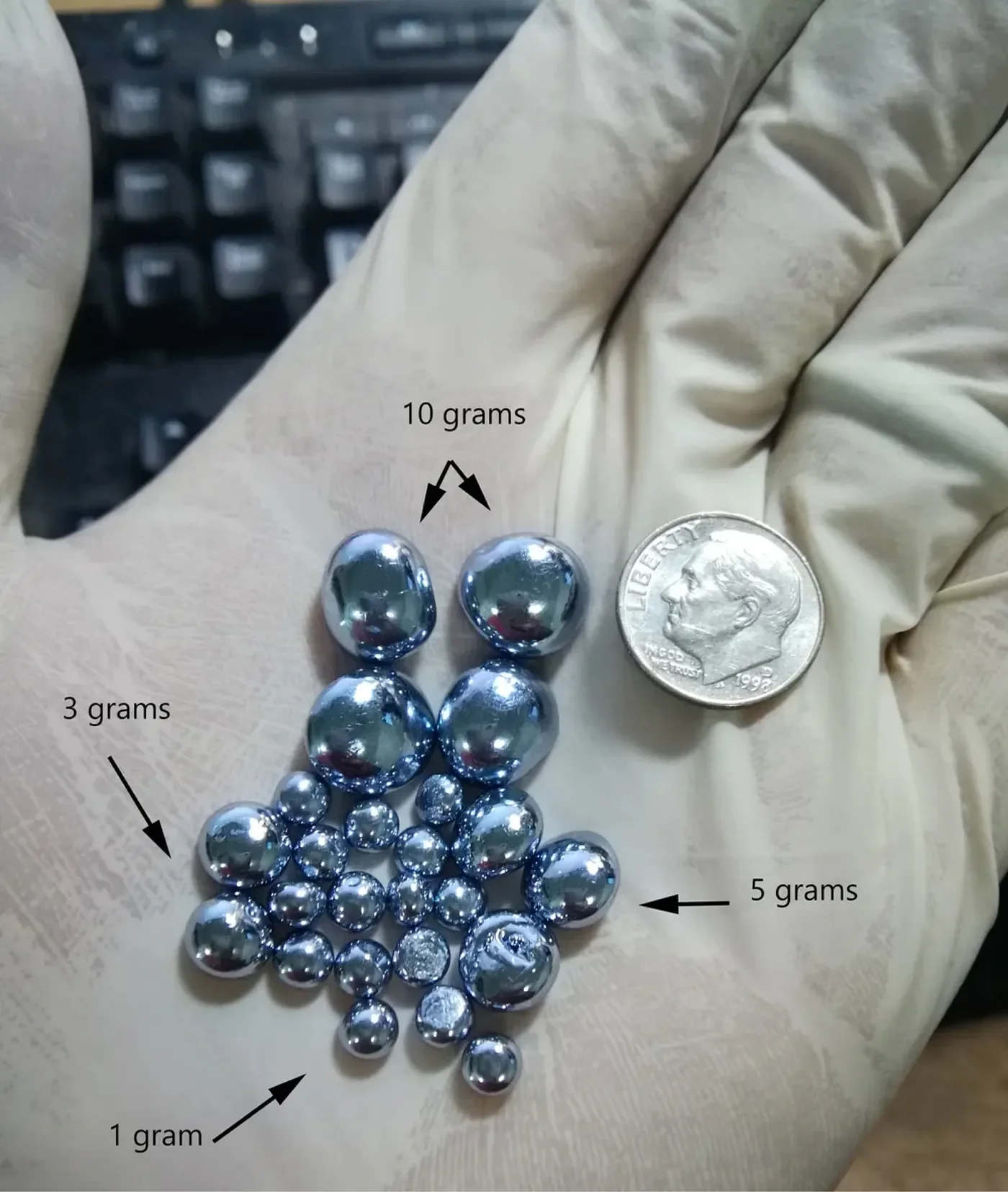
Arc-melted Osmium beads, showcasing the bulk metal form. Source: Luciteria Science.
A gram
The first thing osmium teaches you is how small a gram can be.
I keep a few arc-melted osmium beads in my vault, one gram each bought from Luciteria a couple years ago. Each is about the size of a peppercorn, just over four millimetres across. The same gram of aluminium would be twice as wide and eight times the volume. Even a gram of gold would be larger. You do not feel the density so much as see it: an ordinary quantity of matter, pressed into almost nothing.
Then there is the colour. Not the warm white of silver, nor the grey of platinum, but a faint, cold blue, as though the metal were reflecting a sky that is not in the room. No phone camera I own can hold it; in every photograph I take, the blue flattens into grey. The image above is Luciteria's, taken with equipment built for exactly this. In the hand, the blue is simply there. I have never found the right words for holding it. A bead that small should not contain that much matter, and my senses refuse to agree about it. It reminds me that the elements are not squares on a chart. They were made, somewhere, and one of them ended up in my palm.
Two things about osmium are simply true. It is the densest stable element we know of, and it is one of the rarest in the Earth's crust. Most of what surrounds those two facts is repeated as if it were fact too. This essay takes them in order: the material first, then the market built around it, and only then what it might mean.
The material
Osmium was found in what everyone else threw away. In 1803 the English chemist Smithson Tennant examined the black, insoluble residue left behind when platinum ore was dissolved in aqua regia. Other chemists had written it off as graphite. Tennant found two new metals in it, iridium and osmium, and reported them to the Royal Society in 1804. He named osmium after the Greek osme, "a smell", for the sharp, chlorine-like odour of its oxide.
Its density is 22.59 grams per cubic centimetre. A single litre of osmium would weigh about 22.6 kilograms, just under what most airlines allow for an entire checked suitcase. Even this fact took a long time to settle. Iridium sits at 22.56, so close that each metal was at one time thought to be the densest. Only in the 1990s did X-ray crystallography measure precisely enough to give the title to osmium, by a margin of about a tenth of a percent.
The rest of its profile reads like a list of refusals:
It will not be compressed. Its bulk modulus, the resistance to being squeezed, is reported between 395 and 462 GPa, in the range of diamond.
It will not be worked. It is hard but brittle, and it melts at 3,033 °C, the fourth-highest melting point of any element after carbon, tungsten and rhenium. It cannot be forged or drawn like gold; it has to be sintered, alloyed or crystallised.
It will not tarnish. In bulk it is inert, untouched by aqua regia, and it stays lustrous even when hot.
But osmium has a second face. As a fine powder it slowly reacts with air to form osmium tetroxide, OsO₄: volatile, highly toxic, and the source of that smell. The same compound is also osmium's most useful form. It stains cell membranes for electron microscopy, has been used to raise fingerprints, and sits at the heart of the Sharpless dihydroxylation, which earned a Nobel Prize in 2001. The metal is the noble one; the oxide is the one that works.
The colour has an explanation too. Osmium's reflectivity dips in the red and orange part of the spectrum and peaks in the blue-violet, at about 3 electronvolts. What the eye reads as a cold blue is the metal handing back more blue light than any other colour.
Born in collision, scattered thin
Osmium was not made on Earth, nor in an ordinary star. Elements this heavy are built largely by rapid neutron capture, the r-process, which needs conditions of almost absurd violence. In August 2017, gravitational-wave detectors caught two neutron stars merging, and telescopes watched the glow that followed. That glow, a kilonova, carried the signature of freshly made heavy elements, the first direct confirmation that such collisions forge them. A 2026 study goes further, arguing that the debris of a kilonova is a natural place for grains of refractory metals, osmium among them, to condense as dust.
So the romantic line is, for once, close to the truth. Astronomers still debate how much of the r-process happens in mergers and how much elsewhere, but the osmium in my beads may well have been made where two dead stars destroyed each other, perhaps drifting as dust before it ever became part of a planet.
On Earth it is spread almost impossibly thin. A standard geochemical estimate puts it at about 50 parts per trillion of the continental crust. It never occurs alone, only alongside the other platinum-group metals, in the ores of three great deposits: the Bushveld Complex in South Africa, Norilsk in Russia, and Sudbury in Canada.
How much is produced each year? Here the honest answer is that nobody publishes it. Estimates run from under 100 kilograms to about a tonne; the refiner Heraeus has cited 150 to 1,000 kilograms. Producers report osmium lumped together with iridium and ruthenium, if at all, and the United States imported an average of 155 kilograms a year between 2014 and 2021. For comparison, the world mines around 3,000 tonnes of gold and some 7.5 tonnes of iridium a year.
The rarest metal on the market is also the least measured, and that turns out to matter more than the rarity.
A metal nobody mines
There is no osmium mine anywhere on Earth. There never has been. Every gram comes out of refineries whose real business is platinum, palladium, rhodium and nickel. When copper and nickel are electrorefined, the precious metals settle at the bottom of the cell as anode mud, and osmium is separated from that mud at the end of a long chain of dissolving, distilling and precipitating.
Economists call this a joint product, and it changes everything about how scarcity works.
For most commodities, a higher price calls forth more supply: miners dig deeper, reopen closed shafts, process poorer ore. Osmium cannot answer that call. How much of it reaches the market depends on how much platinum-group ore the Bushveld and Norilsk decide to process. Those decisions turn on the prices of platinum, palladium, rhodium and nickel. Double the price of osmium and not one extra tonne of ore will be lifted for its sake, because its share of the value in that ore is negligible. Its supply is, in the technical sense, almost perfectly inelastic, fixed by other people's markets.
And scarcity alone has never been enough to make it valuable. Osmium's industrial history is a history of being replaced:
In the early 1900s, BASF bought up most of the world's osmium to catalyse the new Haber process for ammonia. By 1908 the same team had switched to cheap iron-based catalysts.
In 1902, Carl Auer von Welsbach sold light bulbs with osmium filaments. Within a few years tungsten, more abundant and more stable, had displaced them. The company that grew out of that era still carries the memory in its name: Osram, from Osmium and Wolfram.
Even today, chemists often choose potassium permanganate over osmium tetroxide, accepting lower yields because osmium costs too much.
The clearest evidence comes from the U.S. Geological Survey. Between 1990 and 2010, the nominal price of osmium metal barely moved, sitting near US$950 per troy ounce, around $30 a gram. Adjusted for inflation, its value fell by roughly a third. For two decades, the rarest precious metal on Earth was quietly losing money in real terms.
“For two decades, the rarest precious metal on Earth was quietly losing money in real terms.”
Value is not rarity. Value is rarity relative to what someone wants to do with the thing. Osmium is rare, and for most of its history hardly anyone wanted it.
This is also where the usual circular-economy argument about osmium goes wrong. The platinum-group industry really is one of the most circular in the world. Johnson Matthey estimates that almost 60% of the platinum-group metal used in new products in 2024 was recycled, counting both open and closed loops. But that figure covers five metals, platinum, palladium, rhodium, ruthenium and iridium. Osmium does not appear in the tables at all. And nobody is depleting osmium for short-term gain: outside a few laboratory uses, it is barely consumed.
The price of a crystal
Then, in 2013, something changed. A proprietary process began turning purified osmium into flat, crystalline pieces: stable, safe to hold, and faceted with a surface that scatters light in that particular blue. The Osmium Institutes in Germany and Switzerland distribute them. Each piece is scanned and registered under an Osmium Identification Code in a central database, and because the crystal surface cannot be reproduced, each code matches exactly one object.
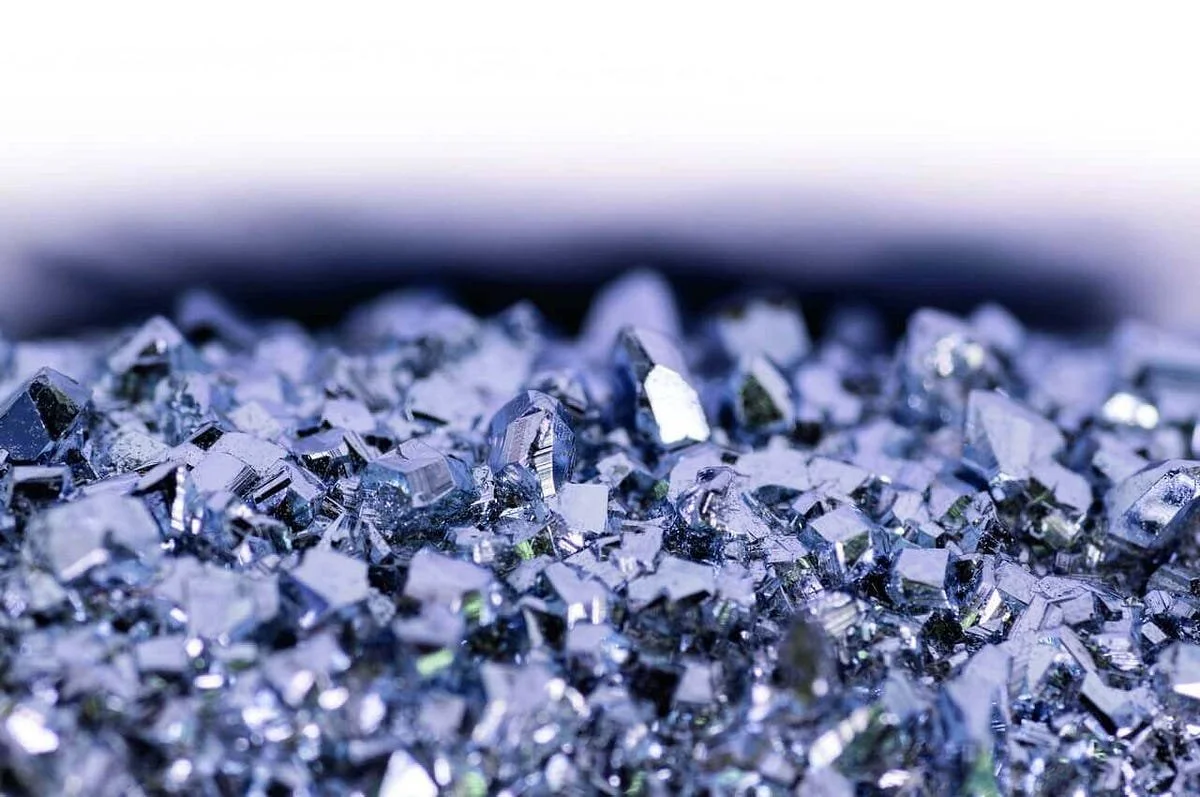
Crystalline osmium. Source: Osmium-Institut GmbH.
A disclosure before going further: in 2025 I designed a piece for a contest the Osmium Institute co-organised. I have no commercial relationship with them, but you should know the connection exists.
Crystalline osmium is what most people now mean when they talk about osmium as an investment. So it is worth being precise about what that market is. On a single day in September 2026, the Institutes' own price site quoted three forms of the same element:
| Form | Price per gram (net, 28 Sept 2026) |
|---|---|
| Fine osmium, purified powder | €54 |
| HighTech-Ready Osmium (HTRO) | €1,149 |
| Crystalline osmium | €2,299 |
Two things stand out. First, the crystal costs roughly forty times the purified metal it is made from. What the buyer is paying for is not the element. It is the crystallisation, the certificate, and the institution standing behind both. Second, the HTRO price is exactly half the crystalline price, to the cent, in euros and in dollars alike. Markets that clear between many buyers and sellers do not produce ratios that tidy. Administered prices do.
And administered is the word. Crystalline osmium is not traded on any exchange. Its price is set by a body called the Osmium World Council, adjusted daily, and published by the Institutes that sell it. That price has risen from about €528 per gram in 2017 to about €2,300 today. It may be a fair price. But it is the seller's price, and a rising line drawn by the seller is not the same kind of evidence as a rising line drawn by a market.
Nor is there one price even for "crystalline osmium". An Austrian dealer, MetaMetals, sells cut crystallised osmium at around €800 a gram, roughly a third of the Institute's figure, while its sintered bars sit at about €50, close to the Institute's price for fine osmium. The products are not identical, and that is precisely the point. The metal converges on one price; the crystal does not.
The real test of any store of value is not the price you buy at, but the price you can sell at, and to whom. The Institute's own guidance recommends holding crystalline osmium for six to ten years before reselling. Dealers say plainly that osmium has no liquid exchange market; owners can resell through marketplaces, but only at whatever another owner will pay.
One German reseller's site is blunter still about how the price works. It says prices were frozen in January 2024 and now move only with the Swiss franc and German inflation. It says future stock will be regulated through price adjustments so that the product never sells out. And it says the last 300 kilograms or so of raw osmium set aside for crystallisation will be finished by the end of 2026. Some of that may be true. All of it is scarcity, and price, announced by the people selling what is scarce.
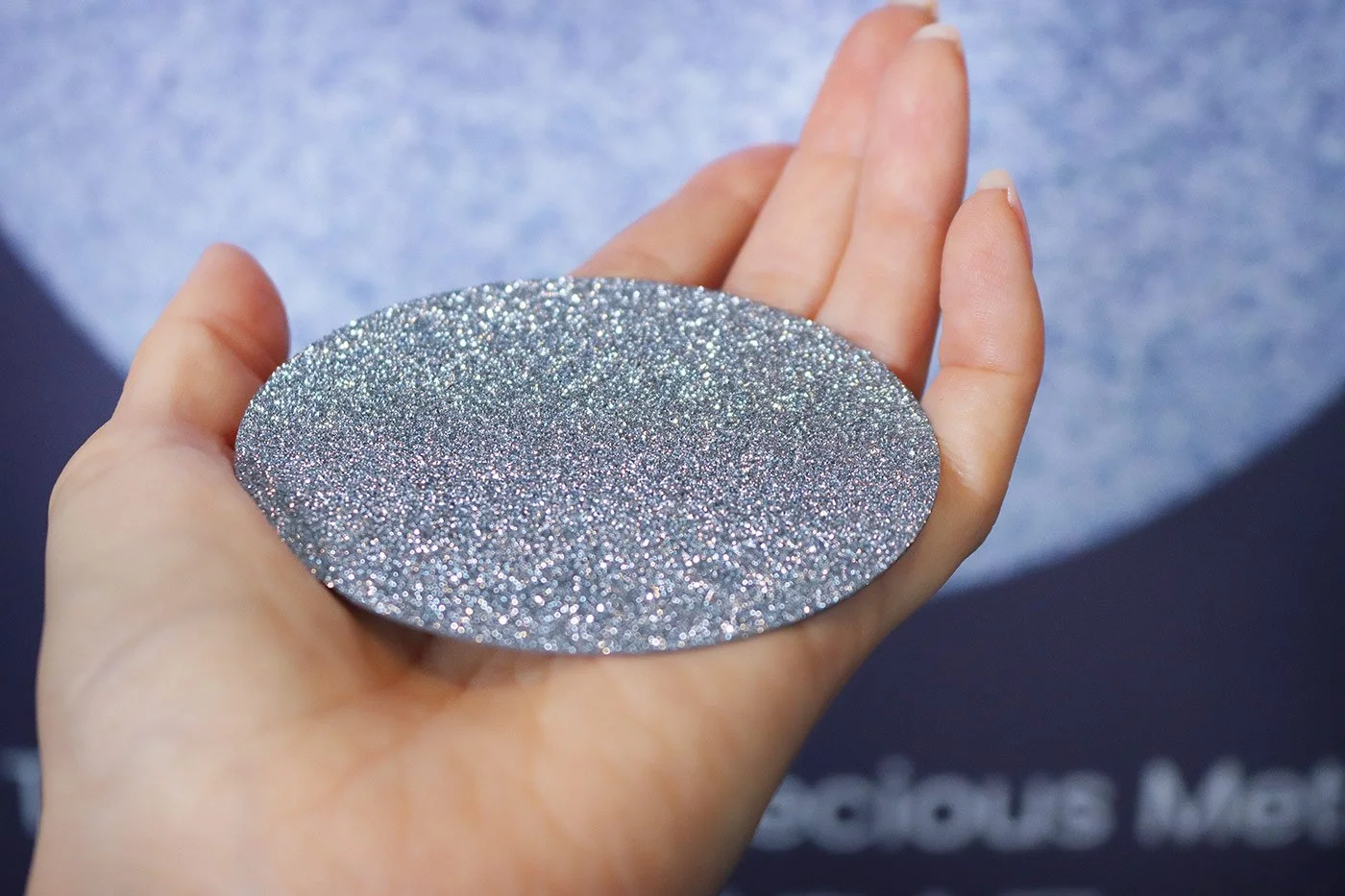
An investment-grade osmium disc. Source: Katerina Perez and Osmium-Institut GmbH.
It is hard not to think of diamonds. De Beers built a century of pricing on controlled supply and a story, around a stone that is not especially rare in the ground. Osmium is the reverse case, and a more interesting one: an element that really is rare in the ground, sold through a structure that looks a great deal like De Beers.
There is one last paradox, and I find it the most beautiful. What makes crystalline osmium impossible to forge is that every piece is unique. But bullion works precisely because it is not unique. One gram of gold is interchangeable with any other, and that fungibility is what makes it liquid. The feature that protects osmium from counterfeiters is the same feature that keeps it from ever behaving like gold. Osmium is often praised because it cannot be traded as paper, only held. That is true. It is also the problem.
“The feature that protects osmium from counterfeiters is the same feature that keeps it from ever behaving like gold.”
The Abyss and the Star
None of this makes osmium less extraordinary. It only makes clear which part of it is extraordinary.
I still see two faces in this metal. The first is the Abyss: the density that packs a gram into a peppercorn, the incompressibility that rivals diamond, the inertness that shrugs off aqua regia. It is matter that does not negotiate. The second is the Star: the cold blue returned from the crystal's surface, and behind it the collision of dead stars where the metal began.
What I understand better now is that both faces belong to the substance, and neither belongs to the price. The density is not a marketing claim; you can feel it. The origin is not a brand story; it is astrophysics, still being worked out. Those things are permanent. The price is made by people, in a room, on a schedule.
This is exactly the distinction this publication exists to draw: luxury as substance, not signal. Osmium is the purest test case I know. The substance is real and verifiable. Much of the signal is manufactured. A serious buyer, or a serious admirer, should know which of the two they are paying for.
A covenant, not a price
My own entanglement with osmium came through making, not buying. In 2025 the Osmium Institute and Katerina Perez ran the Osmium Visionary Contest, asking designers to take the metal beyond investment and chemistry into something a person could wear. My entry was Helica Cosmica, a design that brings all six platinum-group metals together in a single piece, to my knowledge the first. It deserves more than a paragraph, and it will get its own essay.
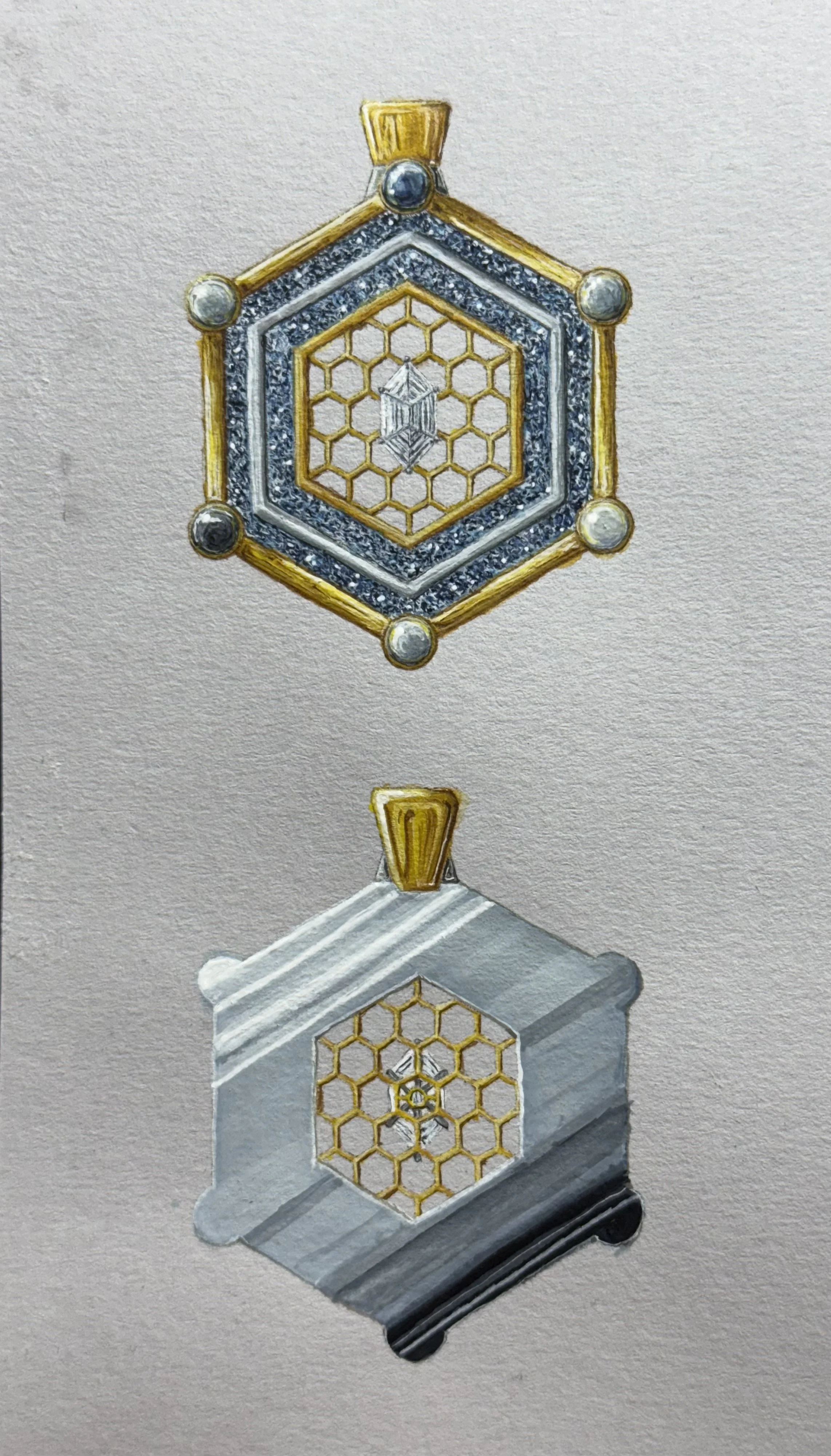
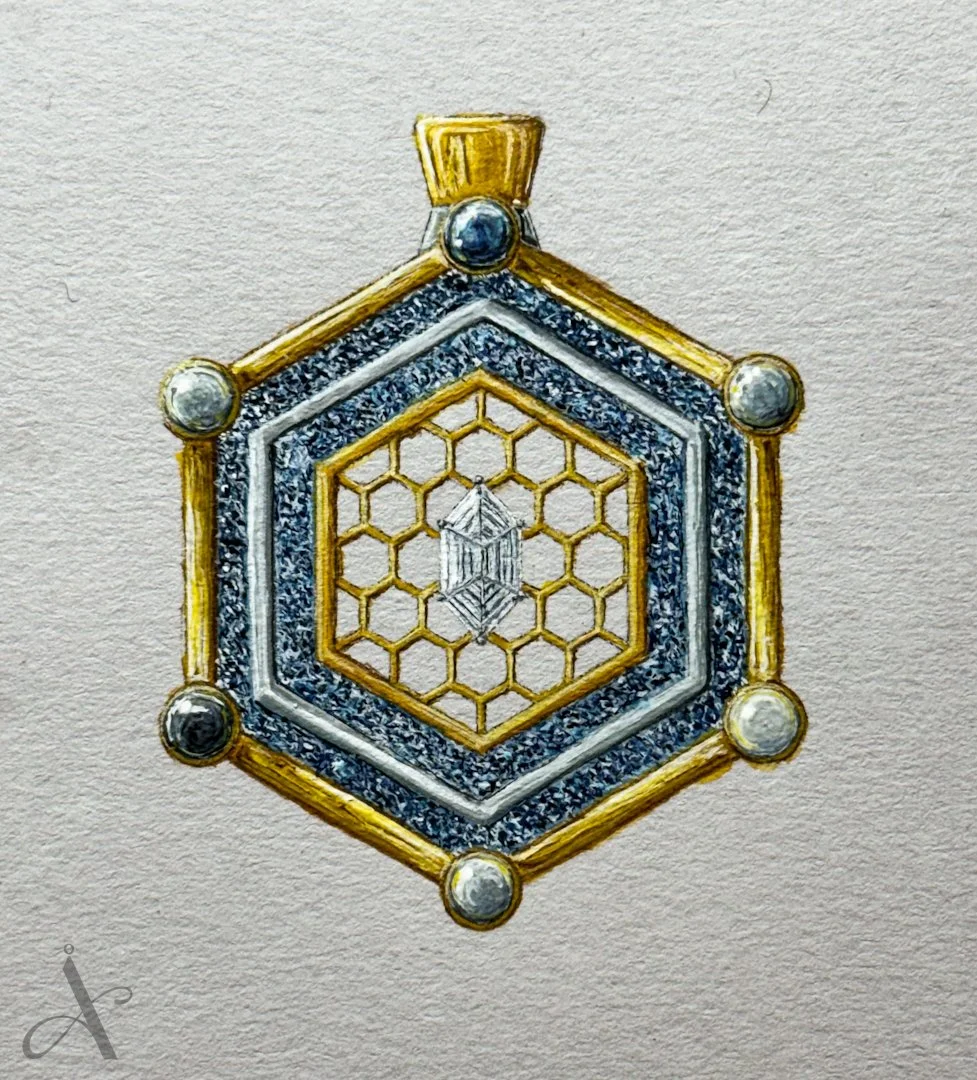
Helica Cosmica, gouache. Max Jacob Koekkoek.
What designing it taught me belongs here, though. Working with a material on paper, you are forced to respect what it will and will not do. Osmium will not be bent, drawn or rushed. You design around its refusals, or you do not design with it at all. This matters because osmium cannot be worked the way a jeweller works gold, silver or platinum. Its properties, and the fact that crystalline osmium is thin and prone to breaking, shift the whole approach: you treat it like a very expensive, fragile gemstone. In practice, the crystal can only be set, as an inlay or held in prongs, while the metal itself enters jewellery as arc-melted beads set in chatons.
Its one great advantage is that, as a flat crystal, it can be cut to almost any outline. That freedom shaped Helica Cosmica. The contest required osmium inlays, so the pendant is built from nested hexagons: an 18-carat gold honeycomb, hand-sawn, around an elongated hexagonal diamond, framed by rings of crystalline osmium one millimetre thick. On the six outer nodes sit six one-gram beads, one for each platinum-group metal: platinum, palladium, rhodium, ruthenium, iridium and osmium. So osmium appears in the piece twice, as the certified crystal and as the plain arc-melted metal. They are the two forms this essay has been trying to tell apart, side by side in thirty millimetres of gold.
Permanence is not a possession, but a practice. Osmium is why I believe it. The metal in my beads will outlast every price ever quoted for it. It will outlast the Institutes, the certificates, the database, and me. None of that permanence can be bought. What can be bought is a crystal, a code, and a promise, each of which is only as durable as the people who stand behind it.
Osmium does not need the market. The market, it turns out, needs a story about osmium. The least we owe the metal is to know the difference.
An earlier version of this essay appeared on Medium in November 2025. This version corrects several figures and replaces its conclusion.
Sources
Osmium, Wikipedia, and the primary sources it cites: Arblaster, "Osmium, the Densest Metal Known", Platinum Metals Review 39(4), 1995; Wedepohl, "The composition of the continental crust", Geochimica et Cosmochimica Acta 59(7), 1995; Tennant, Philosophical Transactions of the Royal Society 94, 1804; USGS Scientific Investigations Report 2012–5188, Metal Prices in the United States Through 2010; Smil, Enriching the Earth, MIT Press, 2004.
Johnson Matthey, Reclaiming the future: PGM insights for a circular economy, white paper, 2025.
Osmium: Price & market, official Osmium Institute price site. Crystalline, HTRO and fine-osmium prices, 28 September 2026.
Osmium price, Osmium Group (independent information site). Price history since 2017.
Monthly purchase plan, Osmium-Institut Germany. Recommended holding period.
Osmium price, MetaMetals. Dealer prices; absence of an exchange market.
Buy osmium, osmium.pro (Protecting Internet Services GmbH). Price freeze, indexation, stock regulation and remaining raw osmium.
Osmium, TM2 Technology Metals Market. Heraeus production estimate.
How Rare is Osmium, Phoenix Refining. Production estimates.
Kasen et al., Origin of the heavy elements in binary neutron-star mergers from a gravitational-wave event, Nature551, 2017.
Domoto, Hotokezaka & Kasen, Heavy element dust explains the late-time spectra of kilonovae, 2026.
Photorealistic modelling of metals from first principles, arXiv, 2019.
Visual credits
Arc-melted osmium beads. Courtesy of Luciteria Science.
Macro image of crystalline osmium. Courtesy of Osmium-Institut GmbH.
Investment-grade disc of crystalline osmium. Courtesy of Katerina Perez and Osmium-Institut GmbH.
Helica Cosmica, gouache. Max Jacob Koekkoek.
