
The Weight of Legacy: Why Precision is the Last True Luxury
An essay on permanence, precision, and the quiet rebellion of true luxury.
There was a time when luxury meant permanence, when the word craft carried the gravity of a vow. What once meant mastery, impeccability, and continuity has been diluted into “branding”. When did creation become campaign? When did “craft” become secondary to “storytelling”?
We once measured value by how long something would last, not by how loudly it could announce itself.
Today, luxury speaks the language of velocity: Limited editions, algorithmic desire, the spectacle of scarcity. The market runs faster, but the craft grows thinner. And yet, beneath the noise, a quieter rhythm endures: the hum of hands and minds that still measure time, beauty, legacy, not in seconds of virality, not in instant gratification & desire, not in meaningless aesthetics, but in balance, meaning, and perpetuity.
Because in a world obsessed with acceleration, precision has become an act of rebellion. Real luxury, true legacy, is not about trend, hype or immediacy; It is the art of permanence through attention. Perhaps the true luxury is not what we possess, but what we devote our time to. If time is finite, then precision, the mastery of it, becomes transcendence.
That is what makes precision so radical today. It asks for patience, for presence, for humility three virtues easily mistaken for inefficiency. But precision is not slow; it is deliberate. It is the decision to let substance outlast spectacle. And it requires not just the mastery of one’s craft, or subject, but demands something more profound, mastery of one’s self.
To file an edge until it catches the light just right. To polish a stone until it speaks. To align what no one will ever see, because integrity begins where eyes no longer reach. These gestures are not acts of excess, but acts of devotion. They are the dialogue between creator and creation, between intention and endurance.
And so, is precision dying, or evolving into something rarer?
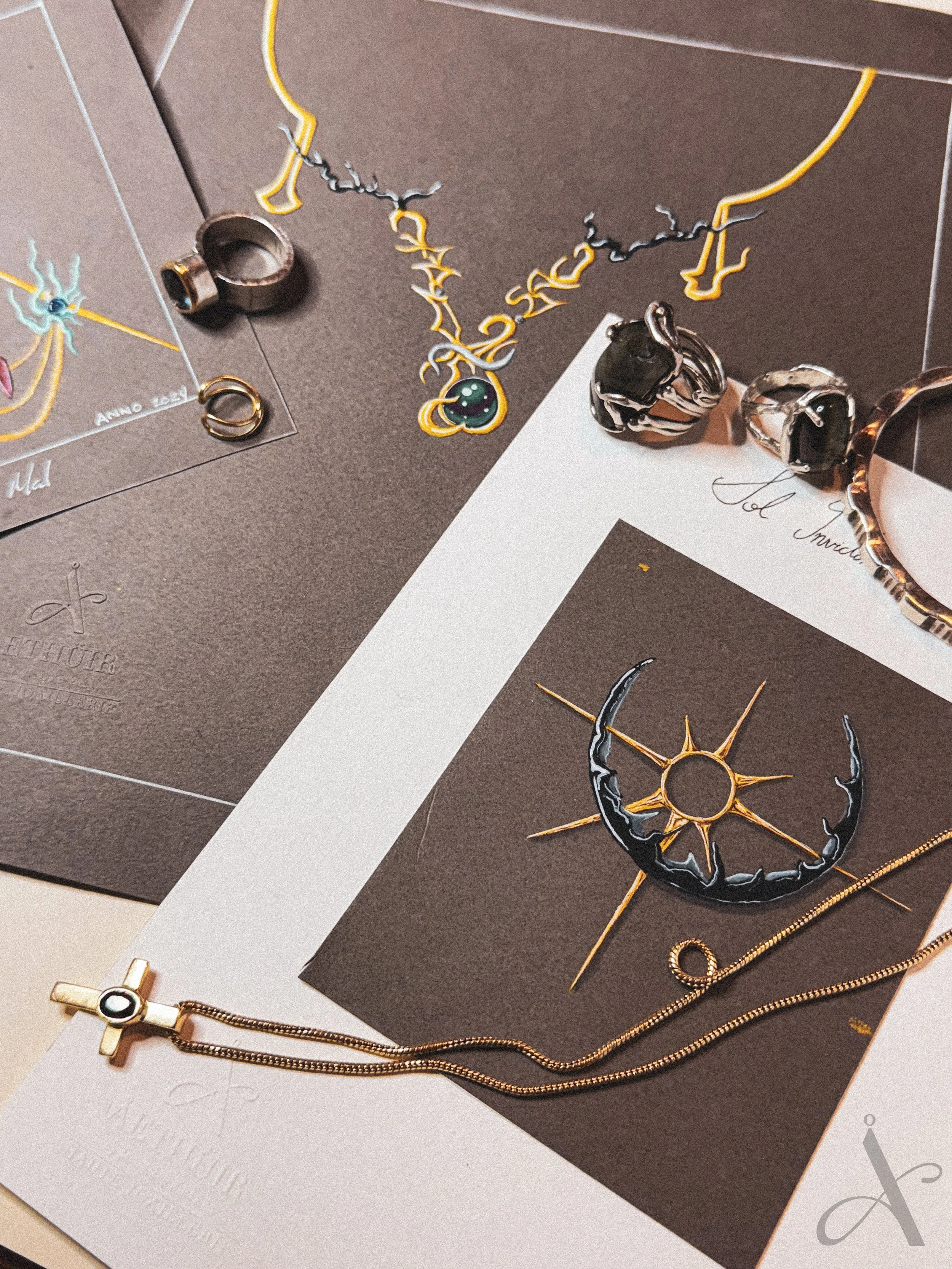
Original gouache and jewelry by Max Jacob Koekkoek explorations in legacy, precision and permanence
Watchmaking taught me to see time as a material, something to sculpt through torque, tension, and breath. That perfection is not the goal; continuity is. Every movement becomes a conversation across generations, across stories. You do not build a caliber to impress; you build it so that someone, a century later, can still feel the intention that shaped it.
And that thought often brings me to Osmium: the densest of metals, (one that I’ll talk in another article) as a silent, incorruptible, patient element. It cannot be rushed or bent by will, nor it cannot be forged by force; it must be understood, not just in the sense of its physical properties but in its symbolical ones as well.
What does it mean for a metal to be uncompromising, and should creators aspire to the same?
In that way, Osmium reminds me that luxury, at its highest form, resists display. It is not like gold which glitters to seduce. It is matter that endures, carrying weight beyond its physicality, and to me, it embodies what luxury, at its highest form, it earns reverence and how legacy should feel like: heavy, incorruptible, unhurried.
That’s the kind of luxury we’ve forgotten, the kind that doesn’t need to prove itself, the one that is not owned, but inherited through endurance. Wether as a declaration of fulfillment and hard work, or as a token of a emotion, of permanence, of legacy.
True beauty, I’ve learned, is structural, in the sense that it does not demand attention; it earns reverence. Jewelry once carried that same gravity a declaration of meaning forged into form. Over time, meaning was replaced with marketing, it became ornament, decoration, display. Yet beneath all that, the original impulse remains: the desire to bind memory into matter.
Perhaps that is what legacy truly is not ownership, but endurance.
When I walk through trade fairs, I can’t help but notice how easily the language of heritage turns into performance. “Craft” becomes a keyword, “authenticity” a campaign. Still, I don’t see this as decay, but more as a moment of reckoning. A chance to ask: how does an industry built on permanence adapt to impermanence? And, can a brand still be sacred in an age of algorithms?
Luxury brands build collections, but legacies build cathedrals. A true maison was once an architecture of meaning, raised through repetition, restraint, and the pursuit of coherence. Today, many behave more like marketplaces. But maybe that’s our test: to rediscover coherence in an era of constant change.
Every great house began with one person who refused to dilute their standard. The craftsman remains the last independent institution a reminder that integrity is a human act. When your methods and your values are one, every gesture becomes a manifesto. You need not speak of legacy; you practice it through silence, through precision, through persistence, until it is fully embodied.
Legacy, then, is not what we leave behind, but what we carry forward. It is not inherited; it is maintained. Those who understand that, who treat precision not as control but as reverence, are building something greater than luxury. They are building continuity, not commodity.
Luxury, at its purest, is awareness: the understanding that the smallest detail can hold the entire story. True artisanship does not shout. It listens. It remembers. And remembrance, perhaps, is the rarest craft of all, because to give form to memory, to bind the invisible into permanence, is to practice continuity in an age that forgets.
Through my craft, through research, through the metals and materials that whisper permanence, I keep pursuing that question how time, material, and meaning might converge again.
Because legacy is not a possession. It is a practice.
Not what you leave behind, but what you live.
